Tuesday, January 18, 2011

The Dilemma of Success: The Solution

So in my last post, I was discussing the inherent problems with being a person or an enterprise that is goal-oriented. In this post, I would like to present a solution that we can use as individuals or as companies that will allow us to not only reap the future benefits of being goal oriented, but also allow us to have the freedom and awareness to remain fluid in our approach. 

You may recognize this video, but take a look at it to remind yourself of what exactly was said:


Now when we finally made it to the moon, did we really gain anything from the actual event of man walking on the moon? No! The quality of life was not enhanced one iota for most people when Neil Armstrong set foot on the moon. Was it a pivotal moment in history? Yes, but it didn't really change the quality of everyday life for people in the slightest.

So what did we get from the moon? Well as a nation, we developed the ability perhaps for better space flight. The goal also forced scientists to come up with better more efficient ways to develop space shuttles and mission control. You could also say that it paved the way for better satellite communications and information technology as a whole. But did all that come from Neil bouncing around up there?? No, that was just the victory lap! That's the same thing as saying a football player spiking a ball in the end zone is the reason he scored a touchdown.

What I'm saying is this: a goal is ultimately just the finish line. The value is not in the goal itself but in the processes, beliefs, habits, and abilities obtained en route to that goal.

Anybody who has ever been successful at anything will tell you that the achievement of the goal is ultimately anti-climatic. Which leads us to ask, what is the point of sacrificing present alternatives or even contentment for a future anti-climatic moment? It just doesn't make sense.

That being said, we can still reap the progressive benefits of being goal-oriented without having to go through every day in a constant state of lack, whether you are talking about an individual or an organization.

Instead of just setting a goal and going for it, break it down into what processes you'll need to achieve that goal. What kind of habits will you need to get into? How do you need to think about it? What is the best way to approach it? Why do you want it in the first place? What skills will you need to master?

An example of the difference is this: let's say you want to make a million dollars in the next five years. You can either learn ways to make it or win some sort of sweepstakes, which one would be more valuable to you? Well, the future value of learning how to make it on your own far exceeds the winning of any sweepstakes because all things being equal, the processes, habits, skills, and approaches you've obtained along the way will probably allow you to do it again and again even further down the road. That is why there are so many turnaround stories of millionaires who lost it all then made it all back again because they had acquired the necessary processes to replicate their success many times over.

By being process oriented, rather than just goal oriented, we create a success engine more like a car rather than a pump-cart on a railroad track. Goals require us to push, processes only require us to steer. What would you rather do? :o)

Think processes and habits. Goals and objectives will change often, processes and habits will not.

Monday, January 17, 2011

The Dilemma of Success: The Catch 22 of Being Goal Oriented

I think we've all have heard of how being goal oriented is one of the habits of highly successful people and enterprises. I know we all can see how being goal-oriented makes logical sense as to why it can lead to success. However, there are some pretty non-obvious things about this mind frame that I'd like to point out.

When an individual or an enterprise becomes goal-oriented, they are essentially saying "Here is my goal. I chose this goal to enhance something to a state of betterment." Because of this, an acknowledged state of discontent is an absolute must. In other words, in order for a goal to become a goal, a person or enterprise has to be willing to admit to themselves that the current state of their objective is inadequate and warrants becoming better

Discontent is the fuel of the "goal-oriented locomotive". Without discontent, the engine does not function and the train doesn't move. The dilemma that this introduces is that being goal-oriented requires one to constantly be in a state of discontent. So my question to you is this: how do you think that mind frame affects the interpretation and experience of the present moment?

In my mind, I believe it seriously diminishes both the experience of the present moment and the value of present and future alternatives. A goal-oriented mind frame both has the advantages and disadvantages of hyper-focus. The advantages being the intensity of one's focus and the disadvantage being one's lack of awareness of equally valuable alternatives.


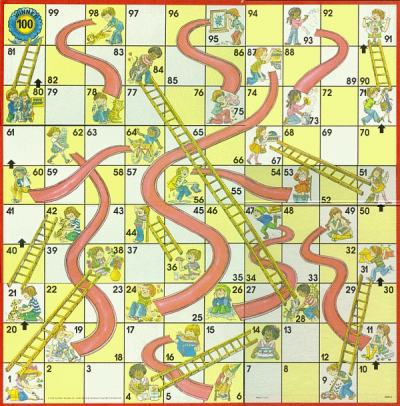
I think we are all familiar with the image of a ladder when it comes to success, however I feel that this image is inadequate and restrictive. The problem with a single ladder is that it restricts you to only two directions: up or down. Have you ever seen firefighters using only one ladder to put out a fire? Rarely, they usually use multiple ladders and even if they were were to use one, they'd move it around. Instead I think when it comes to success, you are better off thinking of it more like this:


Who would have known that you were already learning the principles of success when you were playing games as a child? Ha! This image is a lot more applicable to success because inevitably, success is rarely in a straight line (i.e up or down). You can ask any successful athlete or entrepreneur about this and they will agree. A setback isn't necessarily a step down but could also be one in a whole new promising direction, just like a promotion or an advancement could be a step ultimately in the wrong direction of where we want to be.

All that being said, the inherent value of being goal-oriented is undeniable when it comes to success, but it comes at the high cost of constant discontent. Is there any way we can have our metaphorical cake and eat it too?

Believe it or not there is, which I am going to discuss in my next posting...

Wednesday, January 12, 2011

To All The Mall Vendors Out There: Here's A Better Way To Sell Your Hair Curlers

I was in the mall the other day and started to notice the zigzag pattern I tend to walk when making my way through the mall. Its not because I can't walk in a straight line, its because a straight line in the mall is almost sure to be full of vendors trying to clear your face up, curl your hair, or even (I'm not making this one up...) sell you an oxygen mask...


There's nothing wrong with being a go-getter and having been in retail sales I know that vendors need to move their product. However, its an unwritten law of the universe that when you chase something, you ultimately end up driving it even further and further away. Hmmm...I think even I just realized something right there!

I can't count how many times I've seen and experienced mall vendors annoy, offend, and even intimidate passerbys in the mall. I guess what I'm trying to say is there is a better way to do it, mall vendors.
First of all, drop that default line, "Hey, can I ask you a question?" The answer will always be no. Why? Because you asking for value before you have given any. Instead, move away from your display, about 10 feet away and just smile and greet people, be a diplomat! Just say "Hi, how you doing?" and nod your head as they walk by. You'll actually start to see them slow down and perhaps look at your stand, some might even stop. Give it a try, you'll see it works...

Why does this work? Because you are doing a few subtle things. First, by greeting people and smiling, you are GIVING value first rather than asking them for it. Second, by putting distance between you and your display, you are allowing people to look at your products without fear of being 'sold'. And third, it will allow you to see who your customers really are as they slow down, because chances are while you were chasing someone who wasn't interested you might have missed someone who actually was.

As people stop, you can slowly move in from the side as they browse and ask a genuine question: "so what are you shopping for at the mall today?"...start a conversation and go from there.

Monday, January 3, 2011

For Steve: Why Restaurants Only Give You 2/3 of the Diet Coke

So I get this text from my friend Steve the other day: "Guy...you should write an article about how ice is a scam. Restaurants put it in and it fills up a third of the volume, then you really only bought 2/3 of a soda." So Steve, this one's for you, here's the financial underwriting of restaurant cokes...

Let's say the restaurant sells 45 cokes a day (conservative for most) and it costs them 20 cents a coke, assuming of course they buy in bulk or are mixing their own syrup through the gun at the bar. That's 1,350 cokes a month, costing the restaurants $270. If they charge $1.75 for the coke, their coke revenue is $2,362.50 and their operating profit is $2,092.50.

This is assuming we live in a normal world where when you buy a coke at a restaurant they give you the whole coke, but we don't and they don't, they give you 2/3 of the coke and load the rest of the glass up with ice.

So therefore, though they are selling 1,350 "cokes" they are only 2/3 full, which means they only need to buy 891 of them. That costs them only $178.20 versus $270, saving $91.80 per month, which adds up to an annual savings of $1,101.60. That's ends up being probably more like $800 after taxes, which goes straight to their bottom line.

So how's an extra $800 sound, Steve?

A table on stage at Royale and you're paying? Well alright, I'm not gonna argue with you, just stop yelling at me about it, people are starting to stare...

Pharmaceuticals: Why Are You Even Bothering With Television Advertising?

So I think everybody has seen a commercial advertising a new prescription drug, whether its to quit smoking, birth control, or even those ridiculous Viagra commercials of men doing manly things like changing their oil or saddling up a horse...because real men own a horse, but can't get it up for the little lady.

Part of the requirements of the FDA for prescription drug advertisements on television is that all side effects of the drug must be disclosed in the commercial. But I think we all know the stereotype of how the side effects always seem worse than the original ailment.

I just saw a commercial for a new birth control, Mirena, and distinctly remember exclaiming out loud "Jeez!" One of the side effects included "pregnancy that may occur while on Mirena could cause death or loss of fertility." Which leads me to start to think, at what point does advertising actually start to hurt a product's sales rather than help it? It seems that there's a belief somewhere in the advertising world that any advertising is good advertising when this is clearly not the case. Case in point, girls would you be comfortable taking that pill everyday just knowing that one side effect, nevermind the string of other painful ones they also mention?

The whole point of advertising is to anchor a good feeling to your product in the eyes of your target market. This good feeling creates brand equity when your potential customer sees your product in the store or hears about it from their doctor because they have now become familiar with the product and feel comfortable about it.

If your target market walks away from your advertising scared and thinking "um, no thanks," have you really achieved your goal? Something is broken here...

Saturday, January 1, 2011

A Quick Note on New Year's

New Year's is a funny thing really. It's one of the only days out of the entire year where everyone is both positive and goal-oriented, hence New Year's resolutions. People are all amped up about the next year and all the things they want to do and accomplish. Then comes January 2nd and everybody has an excuse to go back into their foul grumpy moods because after all, New Year's was yesterday!

Why do we choose only to make resolutions on December 31st when there are 364 other just as valid days in a year? Why do we feel so positive one night out of the year when the only difference between that night and other nights is that we are watching a clock and counting backwards??

It seems like one of the best resolutions one could make this year is to treat every day like its New Year's. To be able to wake up and say "it's a brand new day, this one's going to be even better than the last" could give us so much psychological momentum, it would be amazing the experiences we'd have. To consistently start our days with a list of things to do and check them off as we go along could reinforce such a can-do attitude that all of a sudden that mountain of debt doesn't look so daunting, or that weight loss program too hard, or that promotion so far off as you thought!

New Year's isn't just an event, it's a state of mind we can have year round. So if I see you in June and I wish you a Happy New Year, you might not think I'm so crazy after all, right?

Ehh, let's not push it, John...

;O)

Tuesday, December 21, 2010

P90X Results and What I Learned

So I finally finished my three month commitment to P90x and here's a final picture of my results:


All in all the whole program was amazing and was more than just a weight loss program, it was a total change in lifestyle going forward. Though the physical results I achieved through it are great, what was the most valuable aspect of the program is the mental durability you acquire. I noticed that from Day 1 you aren't just training your body, you are training your mind to a level it hasn't yet achieved. The complete transformation happens throughout the program between mind and body until by the end they match each other in leanness and durability.

I can't tell you how much the program has not only advanced my fitness a hundred fold, but the mental discipline I acquired from it will stay with me forever. I'm fully confident that nothing in the business world can break me down now ever because of the mental durability I now have. I stand by the fact that if you can do this program, you can do anything you put your mind to.

If any of you decide to try the program, let me bestow some words of advice. First of all, buy all the equipment needed. The total investment will probably cost you upwards of $300, but trust me if you want the change its worth it. If you torrent the program or if you just borrow the equipment from someone you have nothing invested in the program and it will make it easier for you to quit. Anytime I felt like not working, I'd remind myself of the money I just wasted and that was a huge motivation to get off my ass.

Second, follow the nutrition plan to the 'T'! If you do not you will be supremely disappointed. If there's one thing I realized from this program is that exercise & nutrition go hand in hand...having one without the other is the equivalent of a boxer going into the ring and using only one hand. Cut out the high glycemic index carbohydrates, refined sugars, and bleached flours.

Third, and I know this is going to be a tough one for a lot of people, is alcohol consumption. I did consume alcohol on the weekends, however, I changed my drinks of choice to bacardi and diet cokes, vodka w/ Fresca, or vodka and Sprite Zero. This way even though I was taking in extra calories from the alcohol, I wasn't having a ton of carbs with it to store those empty calories as fat. Even still, I wonder what my results would've been if I had cut it out completely and I'm starting to taper it down even more because I still want to take it to the next level (six pack baby!).

Fourth, you are going to be in A LOT of pain the first two weeks because you will not be used to working out at this intensity level. Just remember to push through it because the first two are the hardest, especially for Ab Ripper X. I've played every sport known to man up through high school, did seven years of jiu jitsu and mixed martial arts, and am a certified trainer through ACSM and I can still honestly say that this was the hardest training program I've ever done out of everything else.

I do recommend that you invest in some supplements to ease the pain and help with muscle rebuilding including creatine monohydrate, a whey protein powder, casein protein powder for before bedtime, and glutamine (either powder or pill form). If I didn't have these I can't imagine how much more painful the whole program would have been, so make the investment.

Another couple tidbits stick to complex carbohydrates and try to keep them in the morning at breakfast and after your workout. Cut out the cheese and substitute either fat free cheese or Laughing Cow Light spreadables (only 3 grams of fat). And after 8pm, no more carbs!

Anyways if you ever have any questions or just need some advice should you decide to do the program, just send me a message and I'd be glad to help you out.